Buy esafetyaware.eu ?
We are moving the project
esafetyaware.eu .
Are you interested in purchasing the domain
esafetyaware.eu ?
domain@kv-gmbh.de · 0541-91531010
Buy esafetyaware.eu ?
What does media literacy mean?
Media literacy refers to the ability to access, analyze, evaluate, and create media in a variety of forms. It involves understanding how media messages are constructed, and being able to critically assess the information and ideas presented. Media literacy also includes the skills to effectively communicate through media, and to use media in a responsible and ethical manner. Overall, media literacy empowers individuals to be informed and active participants in our media-saturated society. **
Does the truth really need media literacy?
Yes, the truth does need media literacy. Media literacy helps individuals critically analyze and evaluate the information they consume, enabling them to discern between factual information and misinformation. In today's digital age, where information is easily accessible and can be easily manipulated, media literacy is essential for ensuring that the truth is not distorted or misrepresented. By being media literate, individuals can better navigate the vast amount of information available to them and make informed decisions based on accurate and reliable sources. **

Similar search terms for Literacy
Top-Angebote
Products related to Literacy:
-
What are the differences between mathematical literacy and mathematics?
Mathematical literacy refers to the ability to understand and use mathematics in everyday life, such as interpreting data, making decisions based on numerical information, and solving practical problems. It focuses on the application of mathematical concepts in real-world situations. On the other hand, mathematics is the academic discipline that involves the study of numbers, quantities, shapes, and patterns, and the relationships between them. It is a more formal and abstract study of mathematical concepts, often involving rigorous proofs and theoretical frameworks. While mathematical literacy emphasizes practical application, mathematics focuses on theoretical understanding and development of mathematical principles. **
-
What are the differences between basic mathematical literacy and mathematics?
Basic mathematical literacy refers to the ability to understand and use fundamental mathematical concepts and skills, such as arithmetic, basic algebra, and geometry, to solve everyday problems. It involves being able to interpret and use numbers, measurements, and basic mathematical operations in practical situations. On the other hand, mathematics encompasses a much broader and deeper understanding of mathematical concepts, theories, and principles. It involves the study of advanced topics such as calculus, statistics, and abstract algebra, and the ability to apply mathematical reasoning and problem-solving skills to complex and theoretical problems. In essence, mathematical literacy is a foundational understanding of basic mathematical concepts, while mathematics involves a more advanced and comprehensive study of the subject. **
-
Should media literacy not become a mandatory subject in schools?
Media literacy should become a mandatory subject in schools because it is essential for students to develop critical thinking skills and the ability to analyze and evaluate media messages. In today's digital age, students are constantly bombarded with information from various sources, and it is crucial for them to be able to discern between credible and unreliable sources. Media literacy also helps students understand the impact of media on society and their own lives, empowering them to make informed decisions. By integrating media literacy into the curriculum, schools can better prepare students to navigate the complex media landscape and become responsible, discerning consumers of information. **
-
Does anyone know good arguments for why media literacy is so important?
Media literacy is crucial in today's digital age because it helps individuals critically analyze and evaluate the information they consume. By understanding how media messages are constructed and the potential biases they may contain, people can make more informed decisions and avoid being manipulated by false or misleading content. Media literacy also empowers individuals to be active and responsible participants in society, enabling them to engage in meaningful discussions, challenge misinformation, and contribute to a more informed and democratic society. **
When can one expect measures to promote media literacy in children and adolescents?
Measures to promote media literacy in children and adolescents can be expected to be implemented in educational settings, such as schools and after-school programs. Additionally, parents and caregivers can also play a crucial role in promoting media literacy by engaging in conversations with their children about media content and teaching them critical thinking skills. Furthermore, government and non-profit organizations may also implement initiatives to promote media literacy through public awareness campaigns and policy advocacy. Overall, promoting media literacy in children and adolescents is an ongoing effort that involves collaboration between various stakeholders. **
What responsibility do parents and legal guardians have in promoting media literacy in children?
Parents and legal guardians have a significant responsibility in promoting media literacy in children. They should actively engage with their children about the media they consume, teaching them to critically analyze and question the messages and content they encounter. It is important for parents to set guidelines and boundaries for media use, and to model healthy media consumption habits themselves. By fostering open communication and providing guidance, parents and legal guardians can help children develop the skills to navigate and understand the media landscape. **
Top-Angebote
Products related to Literacy:
-
Sewing Online Fabric Storage Bag Pink 59L5-piece Craft and Sewing Storage Bundle, Hot Pink Floral – Includes Sewing Machine Trolley Bag, Collapsible Caddy, Desktop Tote, Hexagonal storage Box and Craft Shoulder bag suitable for sewing, art supplies, paper craft and knitting. Transport and Store your Sewing Machine and craft essentials in this 5 Piece co-ordinated Storage Set. Protect and transport your sewing machine to and from sewing classes in this Hot Pink Floral trolley bag. This also comes with a matching collapsible caddy, Desktop Tote, Hexagonal Storage Box and Shoulder Bag, plenty of room to keep all your sewing accessories organised. Whether you're sewing, paper crafting, knitting or just want a set of storage bags and totes this is the perfect solution! This bundle contains an impressive amount of storage space for any crafter at home or on the go. Trolley Bag: * Dimensions: L 40cm (15.7ins) x W 25cm (9.8ins) x 38 cm (14.96ins) * The zip down front panel allows for easy access to your machine. * Stabilizing strap keeps your machine secure. * Includes lockable handle * Innovative collapsible design makes for easy storage when not being used. Collapsible Caddy: * Dimensions: L 30.48cm (12″) x W 20 cm (7.87″) x H 18 cm ( 7.08″) * With two reinforced strong handles, you can bring this tote anywhere, and can be easily stored when collapsed and not in use. * features 13 different storage spaces for supplies. Desktop Tote: * Dimensions: L 23.5cm (9.25ins) x W 15.24cm (6ins) x H 24cm (9.4ins) * Features convenient and sturdy carry handle. * 3 Internal Storage Pockets and 9 side pockets. Hexagonal Storage Box: * Dimensions: L 24cm (9.4ins) x W 24cm (9.4ins) x H 14cm (5.5ins) * Features 4 Internal collapsible storage compartments and 6 side pockets. Shoulder Bag: * Dimensions: L 47cm (18.5ins) x W 14.5cm (5.7ins) x H 27.5cm (10.8ins)-(Not including strap) * Total Strap length 78cms * Zip Top Closure * 1 main Internal compartment and 2 side pockets. Sewing Online94,56 £*Shipping: 0,00 £Secure redirect to the provider
-
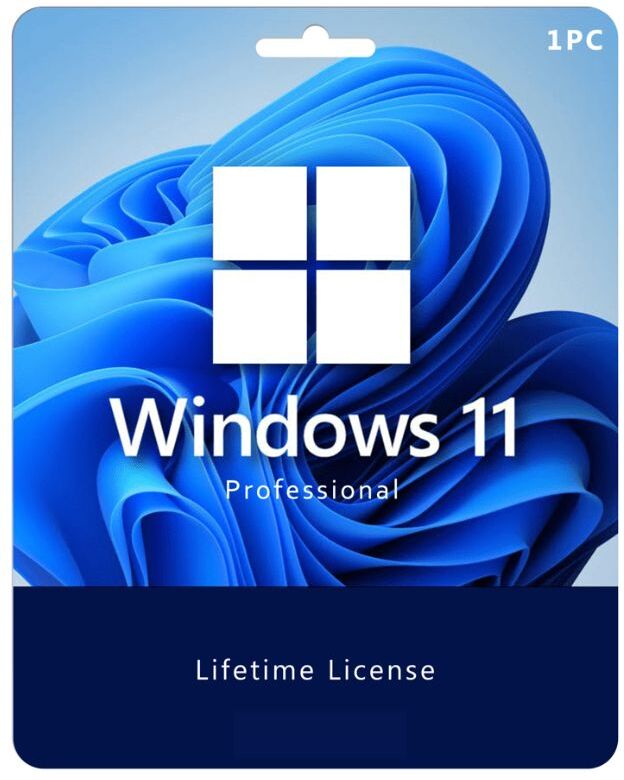
Microsoft Windows 11 pro - Online Activation - LifetimeBuy Microsoft Windows 11 Pro with an original lifetime licence and immediate online activation. Receive your activation key directly by email immediately after purchase and start using all the advanced features of Microsoft's most modern operating system. ✨ Main features Windows 11 Pro is the professional version of the Microsoft operating system, designed to offer maximum performance, advanced security and professional tools for work and productivity. 🔐 Advanced Security BitLocker : Full disk encryption to protect your sensitive data Windows Hello : Biometric access with facial recognition or fingerprint Integrated antivirus protection Microsoft Defender with real-time protection Device encryption : Automatic protection of your files and folders 💼 Professional Features Remote Desktop : Access your PC from anywhere securely Hyper-V : Integrated virtualisation to run virtual machines Azure AD Join : Integration with Azure Active Directory for enterprise environments Group Policy Management : Advanced control of system configurations Windows Update for companies : Customised Update Management 🚀 Performance and Productivity Improved multitasking : New Snap layouts to organise windows Virtual desktops : Create separate workspaces for different projects Customisable widgets : Quick access to the information you need Microsoft Teams integrated Simplified communication and collaboration Compatibility with Android apps : Run Android applications directly on Windows 🎨 Modern Design Renewed interface : Centred start menu and elegant design Improved dark mode : Reduces eye fatigue Fluid visual effects : Animations and optimised transitions Customisable themes Adapt Windows to your style 📋 System Requirements Minimum Requirements Processor 1 GHz or higher with at least 2 cores on a 64-bit compatible processor or System on a Chip (SoC) RAM 4 GB or more Disk space 64 GB or higher Firmware UEFI, with support for Secure Boot TPM : Trusted Platform Module (TPM) version 2.0 Graphics card Compatible with DirectX 12 or higher with WDDM 2.0 drivers Display : HD screen (720p) with diagonal measurement greater than 9 inches, 8 bits per colour channel Internet connection : Request for updates and certain functionalities 📦 What you receive ✅ Original Microsoft Windows 11 Pro Lifetime Licence ✅ Activation key (Product Key) permanently valid ✅ Immediate delivery by email (within minutes of purchase) ✅ Complete installation and activation instructions in Italian ✅ Dedicated customer support for any questions or problems ✅ 100% money back guarantee if the key does not work 🔧 How Activation Works Simple and Fast Process Buy the licence in our store Receive the activation key by email immediately Install Windows 11 Pro on your PC (you can download the ISO from the Microsoft website) Activate using the key provided Enjoy Windows 11 Pro for life with no deadlines! Immediate Online Activation There is no need to wait for physical delivery. Your licence is sent instantly by...3,45 £*Shipping: 0,00 £Secure redirect to the provider
-
What does media literacy mean?
Media literacy refers to the ability to access, analyze, evaluate, and create media in a variety of forms. It involves understanding how media messages are constructed, and being able to critically assess the information and ideas presented. Media literacy also includes the skills to effectively communicate through media, and to use media in a responsible and ethical manner. Overall, media literacy empowers individuals to be informed and active participants in our media-saturated society. **
-
Does the truth really need media literacy?
Yes, the truth does need media literacy. Media literacy helps individuals critically analyze and evaluate the information they consume, enabling them to discern between factual information and misinformation. In today's digital age, where information is easily accessible and can be easily manipulated, media literacy is essential for ensuring that the truth is not distorted or misrepresented. By being media literate, individuals can better navigate the vast amount of information available to them and make informed decisions based on accurate and reliable sources. **
-
What are the differences between mathematical literacy and mathematics?
Mathematical literacy refers to the ability to understand and use mathematics in everyday life, such as interpreting data, making decisions based on numerical information, and solving practical problems. It focuses on the application of mathematical concepts in real-world situations. On the other hand, mathematics is the academic discipline that involves the study of numbers, quantities, shapes, and patterns, and the relationships between them. It is a more formal and abstract study of mathematical concepts, often involving rigorous proofs and theoretical frameworks. While mathematical literacy emphasizes practical application, mathematics focuses on theoretical understanding and development of mathematical principles. **
-
What are the differences between basic mathematical literacy and mathematics?
Basic mathematical literacy refers to the ability to understand and use fundamental mathematical concepts and skills, such as arithmetic, basic algebra, and geometry, to solve everyday problems. It involves being able to interpret and use numbers, measurements, and basic mathematical operations in practical situations. On the other hand, mathematics encompasses a much broader and deeper understanding of mathematical concepts, theories, and principles. It involves the study of advanced topics such as calculus, statistics, and abstract algebra, and the ability to apply mathematical reasoning and problem-solving skills to complex and theoretical problems. In essence, mathematical literacy is a foundational understanding of basic mathematical concepts, while mathematics involves a more advanced and comprehensive study of the subject. **
Similar search terms for Literacy
-
Should media literacy not become a mandatory subject in schools?
Media literacy should become a mandatory subject in schools because it is essential for students to develop critical thinking skills and the ability to analyze and evaluate media messages. In today's digital age, students are constantly bombarded with information from various sources, and it is crucial for them to be able to discern between credible and unreliable sources. Media literacy also helps students understand the impact of media on society and their own lives, empowering them to make informed decisions. By integrating media literacy into the curriculum, schools can better prepare students to navigate the complex media landscape and become responsible, discerning consumers of information. **
-
Does anyone know good arguments for why media literacy is so important?
Media literacy is crucial in today's digital age because it helps individuals critically analyze and evaluate the information they consume. By understanding how media messages are constructed and the potential biases they may contain, people can make more informed decisions and avoid being manipulated by false or misleading content. Media literacy also empowers individuals to be active and responsible participants in society, enabling them to engage in meaningful discussions, challenge misinformation, and contribute to a more informed and democratic society. **
-
When can one expect measures to promote media literacy in children and adolescents?
Measures to promote media literacy in children and adolescents can be expected to be implemented in educational settings, such as schools and after-school programs. Additionally, parents and caregivers can also play a crucial role in promoting media literacy by engaging in conversations with their children about media content and teaching them critical thinking skills. Furthermore, government and non-profit organizations may also implement initiatives to promote media literacy through public awareness campaigns and policy advocacy. Overall, promoting media literacy in children and adolescents is an ongoing effort that involves collaboration between various stakeholders. **
-
What responsibility do parents and legal guardians have in promoting media literacy in children?
Parents and legal guardians have a significant responsibility in promoting media literacy in children. They should actively engage with their children about the media they consume, teaching them to critically analyze and question the messages and content they encounter. It is important for parents to set guidelines and boundaries for media use, and to model healthy media consumption habits themselves. By fostering open communication and providing guidance, parents and legal guardians can help children develop the skills to navigate and understand the media landscape. **
* All prices are inclusive of VAT and, if applicable, plus shipping costs. The offer information is based on the details provided by the respective shop and is updated through automated processes. Real-time updates do not occur, so deviations can occur in individual cases. ** Note: Parts of this content were created by AI.